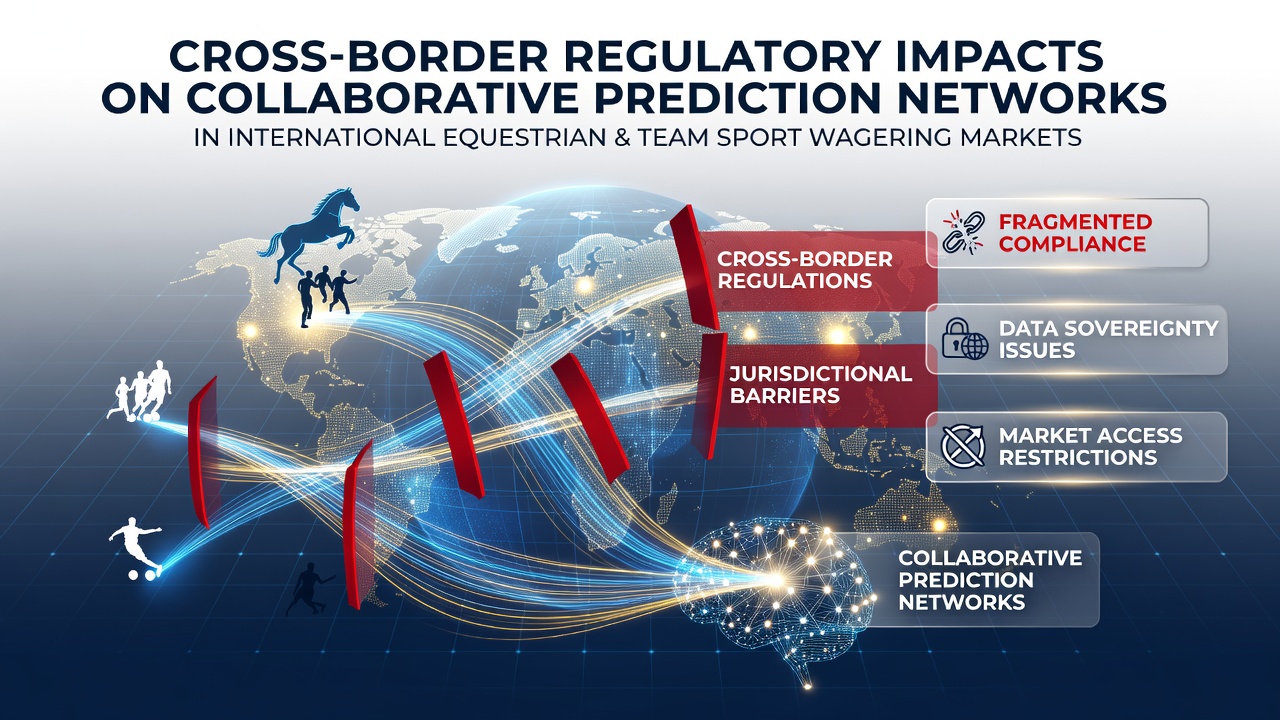
Cross-Border Regulatory Impacts on Collaborative Prediction Networks in International Equestrian and Team Sport Wagering Markets
Regulatory frameworks across multiple jurisdictions shape how collaborative prediction networks operate in international equestrian and team sport wagering markets, with data sharing agreements, licensing requirements, and consumer protection rules creating distinct operational boundaries. These networks rely on pooled statistical models and real-time information exchanges among participants in different countries, yet varying national laws determine the extent to which such collaboration remains feasible without triggering compliance violations.
Regulatory Variations Across Key Regions
European directives on data protection and online services influence how prediction algorithms draw from cross-border datasets involving horse racing results from Ireland, France, and Germany alongside football match data from multiple leagues. Observers note that updates scheduled for October 2026 under revised digital services provisions will require additional transparency reporting from operators who aggregate user-generated forecasts, and this change affects syndicates that combine equestrian form analysis with team sport performance metrics. Meanwhile Australian state-based licensing systems impose separate conditions on foreign entities seeking to integrate local thoroughbred racing data into shared prediction tools, forcing network administrators to segment information flows according to each territory's rules.
Canadian provincial regulators apply distinct standards for sports wagering platforms that incorporate tennis or rugby inputs into collective forecasting systems, and these standards often conflict with approaches taken in Asian markets where horse racing pools operate under different disclosure mandates. Research from academic institutions shows that such fragmentation leads operators to maintain separate data silos rather than unified collaborative models, because a single prediction output distributed across borders can violate multiple sets of licensing conditions simultaneously.
Data Sharing and Compliance Challenges
Collaborative networks in these markets frequently encounter restrictions when attempting to merge equestrian timing statistics with team sport event data for improved accuracy, since privacy regulations in one country may classify certain performance metrics as protected while another jurisdiction permits broader commercial use. According to European Commission reports on cross-border service provision, operators must demonstrate that their prediction algorithms do not inadvertently transmit restricted information when users in different member states contribute inputs. This requirement has prompted several networks to adopt region-specific encryption layers that limit which participants can access combined datasets.

Industry associations tracking wagering technology adoption report that equestrian events scheduled in one time zone often generate data that team sport operators in another jurisdiction wish to incorporate, yet licensing agreements frequently prohibit such transfers without explicit bilateral approvals. Those who manage these networks therefore develop modular architectures where horse racing predictions remain isolated from football or basketball models unless regulatory clearance exists for integration. Figures from trade group analyses indicate that compliance costs for maintaining these separations have risen steadily as more countries introduce location-based restrictions on algorithmic outputs.
Operational Adjustments by Market Participants
Operators respond to these pressures by establishing subsidiary entities in each regulated market, allowing prediction networks to function under local oversight while still exchanging limited summary statistics rather than raw datasets. This approach preserves some collaborative value without breaching rules that treat full data pools as unlicensed betting services when they cross borders. Studies conducted by research centers focused on gaming economics reveal that networks which successfully navigate these constraints often limit membership to participants who agree to jurisdiction-specific terms, thereby reducing exposure to enforcement actions from multiple authorities at once.
Team sport wagering markets face additional layers because match schedules and injury updates circulate rapidly across continents, and any shared model incorporating such information must comply with each country's rules on real-time information disclosure. Equestrian markets encounter similar issues when international breeding and training records feed into collective forecasts that also draw from rugby or soccer performance indicators. Observers note that successful networks therefore implement staged verification processes to confirm regulatory alignment before any new data source joins the system.
Conclusion
Cross-border regulatory structures continue to define the operational scope of collaborative prediction networks in equestrian and team sport wagering by enforcing data segmentation, licensing compliance, and reporting obligations that differ by region. Networks adapt through modular designs and localized entities while monitoring upcoming changes such as those planned for October 2026. According to Australian Communications and Media Authority guidance on digital wagering services, ongoing alignment between jurisdictions will determine how extensively these networks can integrate diverse sporting inputs without fragmentation.