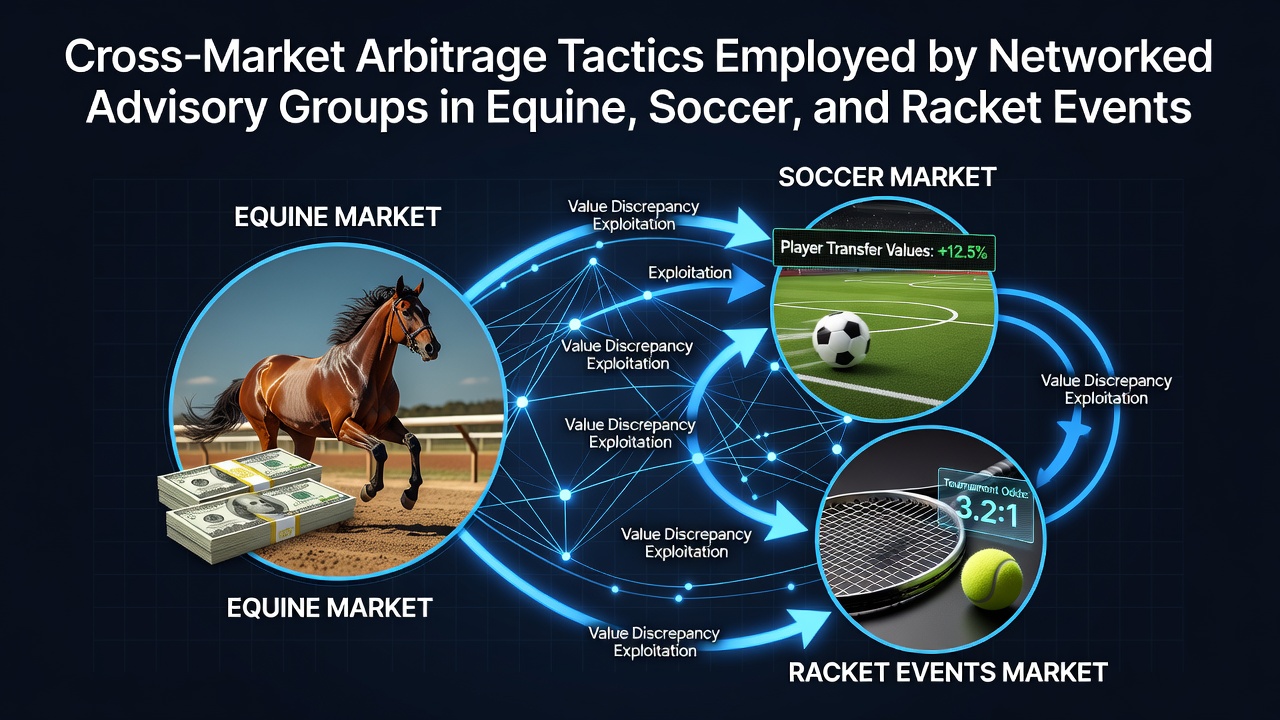
Cross-Market Arbitrage Tactics Employed by Networked Advisory Groups in Equine, Soccer, and Racket Events
Networked advisory groups coordinate information flows across equine, soccer, and racket events to identify price discrepancies that arise when betting markets move independently of one another. These groups operate through shared data platforms that track live odds in horse racing, football matches, and tennis tournaments simultaneously, allowing members to place offsetting positions before lines realign. Research from academic institutions shows that such coordination often exploits the fact that bookmakers in different jurisdictions adjust prices at varying speeds during overlapping event windows.
Core Mechanisms Behind Cross-Market Positions
Advisory networks typically begin by mapping correlated outcomes, such as a horse's performance in a major August meeting that coincides with international soccer fixtures and grand slam tennis sessions. When liquidity thins in one market, odds in another may lag, creating brief windows where a bet on a soccer draw can be hedged against a tennis set total while an equine place market absorbs residual risk. Data from regulatory filings in multiple regions indicate that these groups maintain dedicated analysts who monitor weather impacts on turf tracks alongside pitch conditions and court surfaces, because small changes in one venue frequently influence pricing in unrelated sports through broader market sentiment shifts.
Equine Market Integration Strategies
In horse racing, networked groups focus on each-way and place markets where regional bookmakers price runners differently from global exchanges. Observers note that advisory circles compile historical jockey and trainer statistics alongside live track reports, then cross-reference those figures with soccer goal expectation models and tennis serve percentage trends to determine whether an overpriced equine selection can offset exposure from an underpriced football accumulator. During the summer racing calendar, particularly in periods when major European and Australian meetings overlap with pre-season soccer and hard-court tennis events, these cross-references become more frequent because liquidity pools contract and price discovery slows.
Soccer and Racket Event Overlaps
Soccer markets provide high-volume in-play opportunities that advisory networks pair with tennis set and game betting. Groups track injury announcements and lineup changes in football while simultaneously monitoring withdrawal lists in racket events, then route capital toward the market that shows the largest deviation from expected value. Studies published in peer-reviewed journals demonstrate that such paired positions reduce variance because soccer totals and tennis over-under lines often respond to similar external factors like temperature and humidity. Network participants share encrypted alerts that flag when Asian handicap lines in one league diverge from equivalent moneyline movements in tennis matches scheduled at the same hour.

Operational Structure of Networked Groups
These advisory collectives typically divide responsibilities so that one subgroup handles equine data feeds while another monitors soccer fixtures and a third tracks racket statistics. Communication occurs through secure channels that timestamp every recommendation, allowing rapid execution across multiple betting accounts. Figures released by the Australian Transaction Reports and Analysis Centre reveal patterns where coordinated bet volumes spike when events from all three categories occur within the same twenty-four-hour window. The structure relies on redundant verification steps that compare automated algorithms against human oversight to minimize execution errors during fast-moving arbitrage sequences.
Regulatory Context and Reporting Patterns
Authorities in several jurisdictions require disclosure when betting activity suggests systematic cross-market positioning. According to information from the National Council on Problem Gambling, detection systems now incorporate signals from multiple sports to identify clusters of activity that exceed normal thresholds. Groups adapt by spreading positions across numerous operators and timing entries to coincide with natural market fluctuations rather than isolated spikes. In August 2026, overlapping calendars of the US Open tennis tournament, European football pre-season, and northern hemisphere summer racing meetings are expected to increase the frequency of such coordinated plays as liquidity redistributes across time zones.
Technology and Data Sources
Advisory networks employ custom software that ingests odds from dozens of platforms while applying filters derived from historical performance in equine sprints, soccer corner counts, and tennis tie-break outcomes. University research papers on market efficiency indicate that these tools gain an edge when they incorporate real-time feeds from both regulated and offshore operators. The integration allows members to calculate implied probabilities across asset classes and execute baskets of bets that net to near-zero risk once all legs are filled.
Conclusion
Cross-market arbitrage by networked advisory groups continues to evolve as data access widens and event calendars grow denser. The tactics described rely on speed, coordination, and precise mapping of price relationships between equine, soccer, and racket markets rather than on any single sport's internal dynamics. Regulatory bodies and academic researchers continue to document these patterns through transaction analysis and efficiency studies, providing the factual record against which future developments will be measured.